What to Expect After a CO2 Fractional Laser Treatment, and When
Most of what you have read online was written during the week it looks worst. Here is the whole timeline, including the part nobody stays around to post about.
If you are researching CO2 laser resurfacing, you have almost certainly ended up in a forum thread at eleven at night, scrolling through photos of somebody’s peeling face and wondering what you would be signing up for.
I read those threads too. And after a while I noticed something that changed how I talk to people in consultation.
People post about this treatment on day two, when their face is swollen in a way they have never seen before. They post on day four, when the skin is bronze and sloughing in patches and they cannot leave the house. They post at week three, when the color has not fully settled and the wrinkle they were most worried about is still there. Those are honest posts. They are describing exactly what they see.
What almost nobody does is come back at month four to update the thread.
The reviews cluster at the beginning, when the skin looks its worst. The results arrive at the end, when everyone has moved on.
So the internet’s picture of CO2 laser is skewed toward the middle of the healing curve, and the middle of the healing curve is genuinely unpleasant. Everything below is an attempt to give you the rest of it.
Two different clocks
Healing and results run on separate timelines. Understanding that one gap explains most of the confusion around this treatment.
Days 0 to 2
Redness, swelling, weeping
Days 3 to 6
Bronzing, peeling, redness, skin closes
Week 1 to week 8
Redness fading, texture improving
Months 3 to 6
New collagen, the real result
Most online reviews are written here
Results peak here
The first week, day by day
The timeline below is for the face, and it reflects a deeper resurfacing treatment, which in my practice means a Deka Fusion on the Helix laser. Lighter treatments on the same platform, including CoolPeel Fusion, CoolPeel PDGF and Sultra, move through these same stages faster and less dramatically. Depth, density, the area treated and your own healing all shift the pace.
This is what you will see. Your actual care instructions come from me at your consultation, before you book, so you have time to plan.
| When | What you will see and feel | What is happening underneath |
|---|---|---|
| Day 0, treatment day | Warmth, like a mild to moderate sunburn. Redness with a bronzed cast. Skin feels tight and warm. Swelling starts the same day. | Microscopic columns of tissue have been vaporized. The surrounding skin is intact and already signalling for repair. |
| Day 1 | Swelling is noticeably worse than the day before, often most obvious around the eyes. Skin may weep or ooze. Tightness increases. | The inflammatory phase of wound healing is ramping up. Fluid moves into the tissue on purpose. |
| Day 2 | Swelling is at its worst, then begins to subside. Skin is tender and may start to bronze. | Peak inflammation. This is a normal response to the treatment and part of the wound healing process, not a complication. |
| Days 3 to 4 | Swelling is clearly dropping. Skin turns bronze and takes on a rough texture. Itching starts when the bronzing starts and lasts a few days. Peeling begins, some areas smooth, others still rough. This is when people take the photos. | Treated columns are being pushed out through the skin surface while new epidermis forms underneath them. The patchiness is the process, not a problem. |
| Days 4 to 6 | Redness begins to fade, on average, in patients who had the growth factor applied. Skin becomes intact again and peeling finishes. What remains is color and skin that feels new and thin. Makeup can go back on once the surface is closed. | The skin barrier has reformed. The collagen work has barely started. |
| Week 1 to week 2 | Color continues to settle. Texture is already noticeably smoother. Many people describe a glow at this point. | Fresh epidermis, plus early dermal remodeling. |
You will see seven to ten days quoted almost everywhere online as the downtime for a treatment like this, so a shorter number deserves an explanation rather than a claim. Three things drive it. Settings and coverage are chosen for you rather than run at a fixed protocol. A growth factor application goes on immediately after the treatment, while the channels created by the laser are still open. And the aftercare that follows is controlled, because you are not assembling it yourself.
That last part is not a small factor. In one controlled study, changing the wound healing environment after fractional CO2 shortened average healing time from 7.73 days to 5.73 days and produced significantly lower redness scores.10 Skin intact at five to six days is what I see when all three of those things go right. It is what I observe in my own patients rather than a guarantee, and it is not the same as being back to your normal color.
About the swelling
Swelling is expected after deeper resurfacing and typically builds over the first two days before beginning to settle. It can look dramatic, especially around the eyes, but the progression itself is part of the normal inflammatory phase of healing.
This is the part I coach people through before treatment rather than after, so it does not catch you off guard. If you are worried anyway, call me. I would always rather reassure you than have you wonder whether what you are seeing is normal.
Why I chose the Helix
When people ask why I use the Helix platform rather than another CO2 laser, the answer surprises them, because I was not shopping for another device at all.
When my Cartessa representative asked if he could show me the Helix, I stopped him before he even began. I told him I was not interested in buying another laser. I already owned several devices and was not looking to add one more.
He smiled and asked, “Would you let me treat you with it?” That sounded much more interesting than another sales presentation, so I agreed.
The treatment changed my mind. Experiencing it as the patient instead of the provider allowed me to appreciate the comfort of the treatment, the remarkable level of control the platform offered, and, most importantly, the results that unfolded over the months that followed. My own recovery followed the same timeline I describe in this article.
Only after seeing those results on my own skin did I purchase the Helix. Looking back, it has been the single best equipment purchase I have made for Renew MedSpa.
I do not say that because I believe the machine performs miracles. No laser does. I say it because it gives me exceptional control over depth, density, coverage and treatment modes, so I can customize every treatment to the individual patient instead of forcing every patient into the same protocol. That flexibility is one of the reasons I believe outcomes depend just as much on the provider as they do on the technology.
What this actually looks like
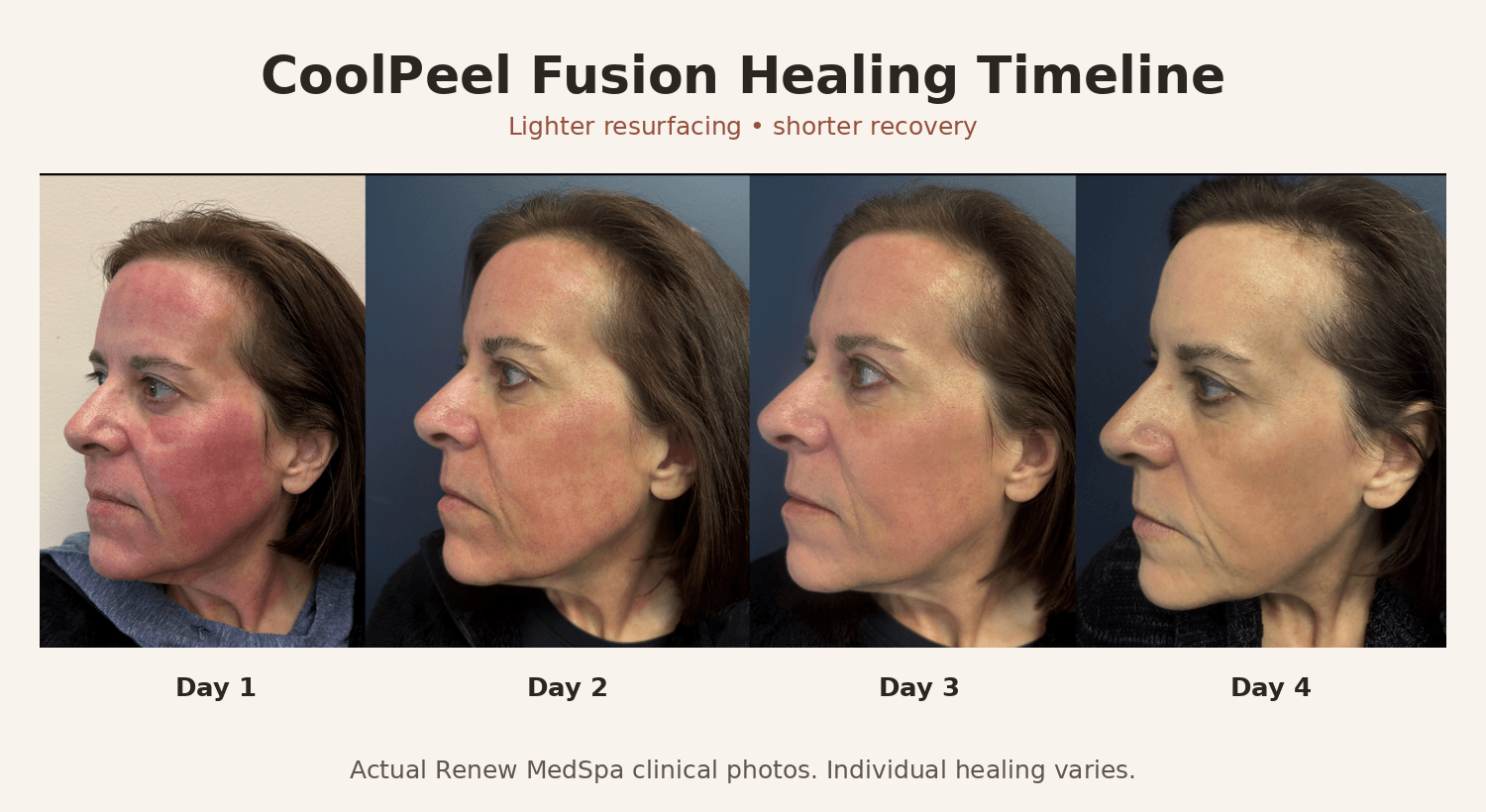
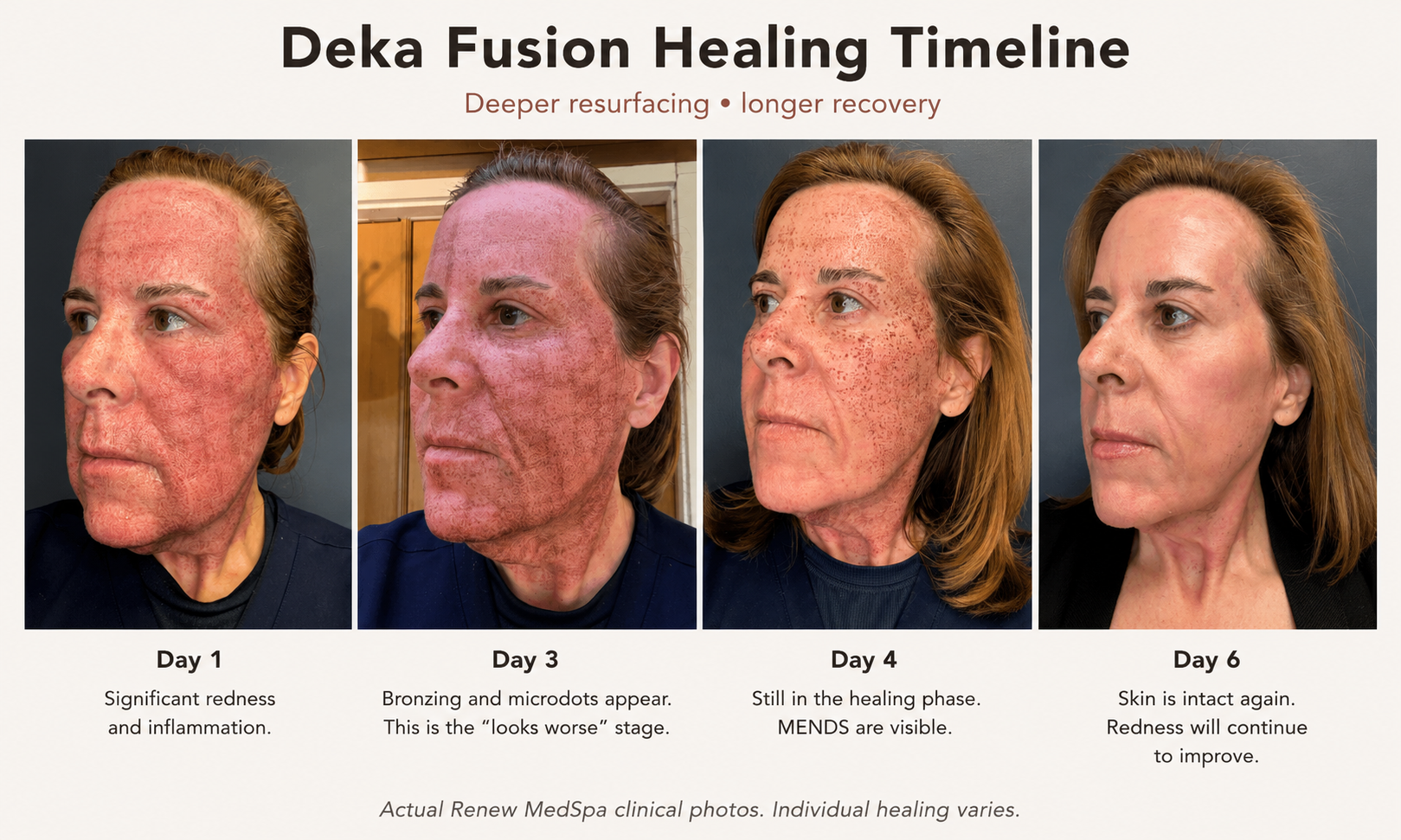
Reading about healing is helpful. Seeing it is better. These are my own clinical photos, so you can compare a lighter CoolPeel Fusion recovery against a deeper Deka Fusion recovery. Every person heals differently and settings matter, but this is the normal progression I prepare patients for.
CoolPeel Fusion healing timeline
With a lighter resurfacing treatment, redness is the main visible change and settles quickly. In my own treatment, the difference from Day 1 to Day 4 was substantial.
Deka Fusion healing timeline
A deeper treatment looks much more dramatic before it looks better. The bronzing and visible microdots are part of the healing process. By Day 6 my skin was intact again, although residual redness continued to improve afterward.
What goes on your skin, and when
Immediately after a treatment your skin has no intact barrier, and the laser has left thousands of open microchannels. Whatever goes on the skin in that window goes in. That is the whole reason the post-treatment period is such a lever on your outcome, in both directions.
The growth factor application
After every Helix treatment I offer an application of ariessence pure PDGF+, a topical post-procedural product made of recombinant platelet-derived growth factor combined with hyaluronic acid.12 I apply it in the treatment room, right after the laser, while the channels are still open. That timing is the entire point. Outside that window the delivery advantage is gone.
It is an optional add-on with its own cost, and I will be straight with you about the evidence: the published trial behind topical pure PDGF was run after radiofrequency microneedling rather than CO2 laser.13 The healing timeline described earlier in this article is what I see in my own patients who have it applied. That is why I recommend it to almost everyone.
What goes on your skin afterward, and what does not
Your aftercare products are included with the treatment. Not sold to you afterward, not something to go shopping for while your face is peeling. You leave with what you need and instructions for what to use on which day.
Use nothing else. Not your usual serum, not the thing that always calms your skin, not a friend’s recommendation, not a product you already own and paid good money for. Skin with an open barrier reacts to ingredients that are completely uneventful on intact skin, and the usual consequences are irritation, prolonged redness and pigment changes.
Going off protocol is one of the few reliable ways to compromise both your healing and your final result. If you are running low on something before the healing window closes, call me. Do not substitute.
Body does not heal like face
If we are treating somewhere other than your face, reset the whole timeline. Skin off the face has fewer of the structures that drive fast repair, so everything takes longer. Closure is slower, and redness at the treated site can linger for up to two months depending on the settings used. That is normal for body work, not a sign something has gone wrong, and it is the single most important expectation to set before we start.
It also changes how we plan. A body treatment needs a longer runway before any event you care about, and it needs more patience from you in the weeks after. If you are working toward a date, tell me the date first and we will build backward from it.
Skin intact is not your result. Skin intact is a wound finishing.
Week two through week six, the quiet part
This is where people get discouraged, and it is worth naming honestly. The dramatic part is over. Your skin looks better than before, but not transformed. The color is still settling. The deep lines you were most focused on may not have moved much yet. If you were expecting the treatment to be finished at this point, this is where doubt sets in.
Nothing is wrong. Redness begins fading in the first week, but the last of the color takes longer to settle completely, and how much longer depends on the depth of your treatment. Clinical trials treat erythema duration as its own recovery endpoint, separate from the surface healing you can actually see finish.1 Meanwhile the real remodeling is happening where you cannot see it. Studies using in vivo confocal microscopy have tracked measurable epidermal and collagen changes still developing at three, six and twelve weeks after a single session.2
- Sun protection matters more now than it did in week one. New skin burns and marks easily.
- Retinoids and strong actives stay out until I clear you, generally four to six weeks.
- Mineral makeup is fine and helps with any residual color.
Months three through six, where the result actually lives
Ablative fractional resurfacing works in two waves. There is an immediate tightening from collagen contraction during the treatment itself, and then a much slower, much more significant wave of new collagen production that builds over roughly three to six months.3
This is why I schedule a follow-up with a VISIA scan at five to six months rather than at six weeks. I want to look at your skin when the work is finished, not while it is still in progress. Every face treatment at Renew MedSpa includes two complimentary VISIA scans for exactly this reason, one before and one after, so we are comparing images instead of memories.
What the published research shows
Patient forums are one kind of evidence. Here is the other kind.
Mean improvement in skin texture at two months in a fractional CO2 study, alongside 57 percent for skin tightening and 51.4 percent for wrinkles.3
Of the overall improvement was still maintained at long-term follow-up compared with the three month result, in patients treated with fractional CO2 resurfacing.4
Of subjects were satisfied with their outcome in a study of ultra-pulsed fractional CO2 for periorbital static wrinkles.5
The finding I think about most
One study set out to compare what patients expected before treatment with how they felt afterward. Expectations were already very high going in, and satisfaction still came out slightly higher. But the striking part was this: patient satisfaction did not correlate with the measured reduction in wrinkle size in any facial area.6
People were not happy because a line got shorter by a specific number of millimeters. They were happy because of how their skin looked and felt to them. That matches what I see in the treatment room almost every time, and it is why I spend so much of a consultation asking what someone actually wants to change rather than pointing at a mirror.
What can go wrong, and who this is not for
I would rather you hear this from me than find it in a forum after the fact.
Post-inflammatory hyperpigmentation
This is the most common meaningful complication. Skin responds to the inflammation by producing extra pigment, showing up as darker patches a few weeks after treatment. Reported rates with fractional ablative lasers range widely, from about 1 percent to 32 percent, and the system used, the settings chosen and the patient’s skin type all influence that number.7
It is usually temporary and it is treatable. If it happens to you, we address it and we see it through. I also screen for it before we ever book: if your skin tends to darken or mark after a cut, a scratch or an insect bite, that tells me something important about how you will respond, and it changes the settings I choose.
Prolonged redness
Persistent erythema is the other common delayed effect. In one retrospective review of complications after fractional CO2 across a range of aesthetic indications, persistent redness was the most frequently observed delayed issue, followed by hyperpigmentation.8
Skin type matters, but less than it used to
Fully ablative CO2 carried a hyperpigmentation risk above 37 percent in patients with darker skin. Fractional delivery changed that meaningfully, and studies in Fitzpatrick types IV and V using conservative fractional protocols have reported improvement without post-inflammatory hyperpigmentation.9 Skin type is not a disqualifier. It is a reason to choose settings carefully and to be honest about risk in the consultation.
This treatment is not right for everyone
- If you cannot take the downtime seriously, this is the wrong treatment. There is no shortcut through days two to six, and the aftercare is not optional.
- If you have a wedding, a reunion or a photo shoot inside six months, we plan around it or we choose something lighter.
- If your primary concern is redness rather than texture, tone and lines, a different treatment may serve you better.
- If you are looking for lift rather than resurfacing, this treats the skin, not what is underneath it.
Why the same laser gives different results in different hands
This is the part I most want people to understand before they price shop.
The complication review above reached a conclusion worth taking on its own terms. The authors concluded that although fractional CO2 is relatively safe, poor outcomes tend to trace back to four things: inappropriate selection of laser parameters, poor patient selection, inadequate preoperative counseling and suboptimal postoperative care.8
Every item on that list is a decision made by a person, not by a machine. Settings, patient selection, the conversation before, the care after. None of that is the laser.
At Renew MedSpa I perform every Helix treatment personally. Not a technician, not a rotating provider. I choose the settings, I run the treatment with cold air cooling throughout, and I am the person you call on day four when your face is bronze and itching and you want to know whether that is normal.
So is it worth it
Patient-reported data says yes for most people. On RealSelf, CO2 laser resurfacing carries an 86 percent Worth It rating, with patients reporting smoother, more evenly toned skin. Among those who said it was not worth it, some reported burns and other adverse outcomes.11
My honest answer is more specific than a percentage. It is worth it if three things are true.
- You are treating texture, tone, fine lines, pigment, sun damage or scarring, which is what this laser is genuinely good at.
- You can give it the time, both the week of recovery and the six months of patience.
- You trust the person holding the handpiece, because the research says that is where outcomes are decided.
I do one treatment at a time. Not a package, not a series sold up front. We treat, we let your skin do its work, we look at real images at five to six months, and then we decide together what comes next.
What comes next usually depends on which mode you are in. If you are starting in deep correction mode, working on significant sun damage, scarring or years of accumulated change, you will likely benefit from more than one treatment, spaced about six months apart so each one has time to finish before we build on it. If you already do aesthetic self-care on an ongoing basis, you are probably in maintenance mode, and one treatment a year will hold you there.
The peeling is over in under a week. The collagen works for months. The confidence people notice often lasts much longer.
Neither answer is something I can give you honestly before we have met. This treatment is not just about choosing the right laser. It is about choosing the right treatment for your skin, your goals and your timeline.
Questions we hear about this
For a deeper resurfacing treatment, plan on your skin being intact again at five to six days, with redness still visible after that. Most people take about a week. Whether you are comfortable being seen before the redness settles is a personal call, and makeup helps. Lighter treatments on the same platform need less time.
You probably do not look worse. The glow from freshly healed skin fades as the initial swelling fully resolves, and what is left is the honest starting point before collagen remodeling has done anything visible. Week three is a plateau, not a reversal.
That depends on you and the level of correction you are seeking. If we are starting in deep correction mode, you would likely benefit from more than one treatment, spaced about six months apart. If you already do aesthetic self-care treatments on an ongoing basis, you are likely in maintenance mode, and one treatment a year will maintain you.
I do not decide which one you are in advance. We treat once, we look at real images at your five to six month follow-up, and we decide from there.
Once the skin surface is intact, which is usually day five or six. That is the rule, not a date on a calendar. If your skin has closed, makeup is fine, and mineral makeup helps with the redness that is still there.
Not during the healing window. Your aftercare products come with the treatment and there is a day by day plan for them. Adding anything on top, even something gentle you have used for years, is the most common avoidable cause of irritation, prolonged redness and pigment changes. When your skin is ready for your regular routine again, I will tell you.
No. It is an optional add-on with its own cost. I recommend it to almost everyone because it goes on while the laser channels are still open, and the healing timeline I describe here is what I see in patients who have it. We will talk about it at your consultation rather than at checkout.
We numb thoroughly beforehand and use cold air cooling throughout the treatment. Most people describe the treatment itself as tolerable and the days afterward as feeling like a mild to moderate sunburn rather than sharp pain.
The new collagen is real and it persists. One long-term follow-up found patients still held 74 percent of their improvement at long-term visits compared with their three month result.4 A neck study found scores for laxity and horizontal lines still significantly better than baseline at one year.3 You continue to age, so maintenance keeps you ahead.
Come talk it through first
A consultation is complimentary, and it exists so you can ask the uncomfortable questions before you commit to anything. We will look at your skin, talk about your timeline, and I will tell you honestly whether this is the right treatment for what you want to change. Please book ahead so we can be here and ready for you.
References
- 1. Effect and safety of skincare regimens containing a multi-molecular hyaluronic acid complex for recovery after ablative fractional CO2 laser, a prospective randomized controlled trial. https://www.ncbi.nlm.nih.gov/pmc/articles/PMC12210091/
- 2. Laser skin rejuvenation: epidermal changes and collagen remodeling evaluated by in vivo confocal microscopy. Lasers Med Sci. https://pubmed.ncbi.nlm.nih.gov/22767322/
- 3. Neck rejuvenation with fractional CO2 laser, long-term results. J Clin Aesthet Dermatol. https://pmc.ncbi.nlm.nih.gov/articles/PMC4142817/
- 4. Ortiz AE, et al. Long-term outcomes of fractional CO2 resurfacing, as reported within reference 3. https://jcadonline.com/neck-rejuvenation-with-fractional-co2-laser-long-term-results/
- 5. Efficacy and safety of ultra-pulsed CO2 fractional laser for the treatment of periorbital static wrinkles. Lasers Med Sci. https://link.springer.com/article/10.1007/s10103-025-04342-w
- 6. Fractional carbon dioxide laser resurfacing of rhytides and photoaged skin, a prospective clinical study on patient expectation and satisfaction. https://pubmed.ncbi.nlm.nih.gov/25652114/
- 7. Refractory postinflammatory hyperpigmentation treated with fractional CO2 laser. J Clin Aesthet Dermatol. https://jcadonline.com/refractory-postinflammatory-hyperpigmentation-treated-with-fractional-co2-laser/
- 8. Kaur J, Sharma S, Kaur T, Bassi R. Complications of fractional ablative carbon dioxide laser in various aesthetic procedures, a retrospective study. Int J Res Dermatol. https://www.ijord.com/index.php/ijord/article/view/676
- 9. Low risk of postinflammatory hyperpigmentation in skin types 4 and 5 after treatment with a fractional CO2 laser device. https://pubmed.ncbi.nlm.nih.gov/18720695/
- 10. Evaluation of the therapeutic efficacy of moist wound healing after fractional CO2 laser surgery. https://www.ncbi.nlm.nih.gov/pmc/articles/PMC11841829/
- 11. RealSelf. CO2 laser cost and Worth It rating, based on patient reviews. https://www.realself.com/nonsurgical/co2-laser/cost
- 12. LRM Aesthetics. ariessence pure PDGF+ patient information and frequently asked questions, including ingredients and FDA cosmetic listing status. https://ariessence.com/for-patients/faqs/
- 13. Lynch SE, Huxel ST, Bond R, Biron J, Gold M. Recombinant pure PDGF improves aesthetic results and patient satisfaction following RF microneedling, a prospective, randomized, controlled clinical trial. J Cosmet Dermatol. 2025 Sep;24(9):e70425. https://doi.org/10.1111/jocd.70425