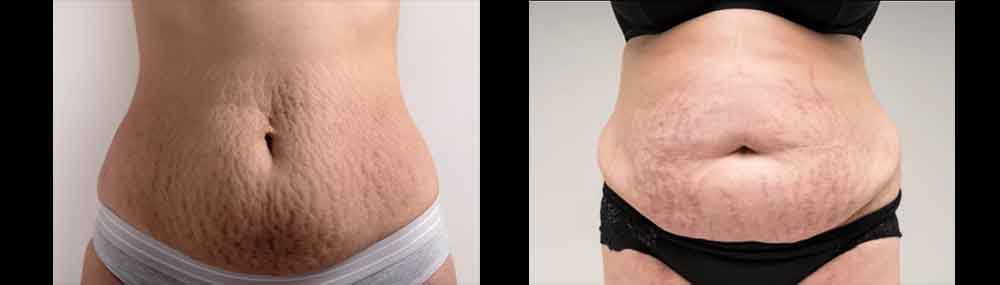
Stretch Marks: Causes and Treatment Options
Stretch marks form deep in the skin, where rapid stretching ruptures collagen and elastin. Here is what causes them, how they change over time, and the treatment we use to soften them at Renew MedSpa in Eagan, MN.
Not sure if you are a candidate? A free consultation is the honest way to find out.
Why stretch marks form
Stretch marks, also called striae, appear when skin stretches faster than it can adapt. The collagen and elastin fibers that give skin its structure tear, leaving narrow streaks that differ from the surrounding skin in both color and texture.
They commonly develop on the abdomen, thighs, hips, breasts, and upper arms after pregnancy, weight changes, growth spurts during puberty, or hormonal shifts. Rapid stretching is part of the cause, but hormonal changes also play a role by affecting how the skin produces collagen and elastin, which is why pregnancy and puberty are such common triggers. They are completely harmless, but for many people they affect confidence. Because they sit deep in the dermis, creams and topical products cannot reach them in a meaningful way.
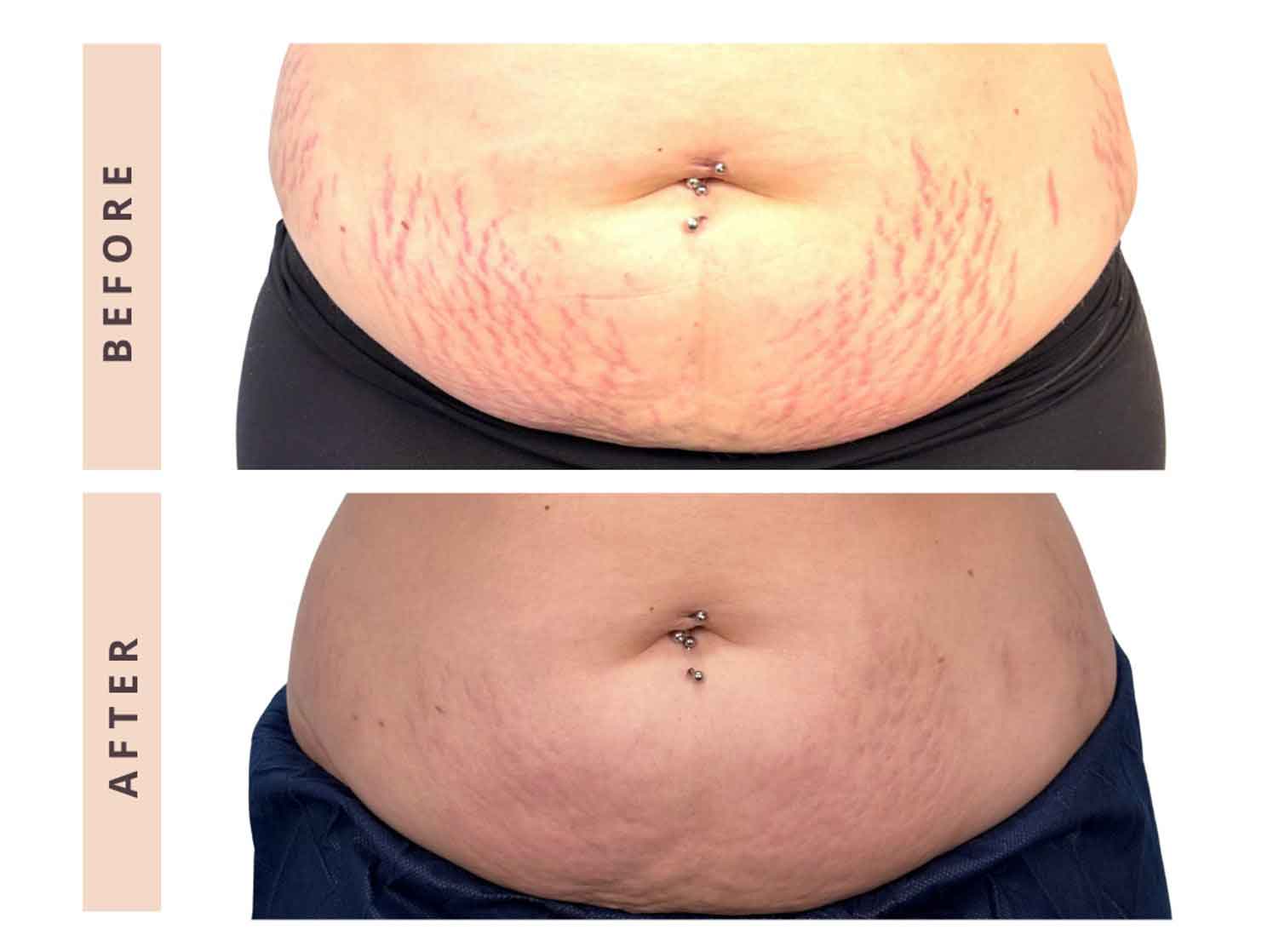
Stretch marks change over time
The color of a stretch mark tells you what stage it is in, and the stage affects both how it responds to treatment and whether waiting makes sense. It is one of the first things we assess at your consultation.
Red, purple, or brown
Newer stretch marks still have an active blood supply and the skin is still remodeling. Because that healing is already underway, this stage tends to respond best to treatment. Some early marks also fade somewhat on their own, so the timing of treatment is worth discussing rather than rushing.
Silver or white
Over time the redness fades, the blood vessels retreat, and the mark settles into a thinner, flatter scar with a slightly sunken or glossy texture. These will not keep improving on their own, which is why treatment matters most here. The good news is that the Helix CO2 rebuilds collagen rather than relying on the blood supply a white mark has lost, so it still helps this stage.
Why this matters: the color is a readout of whether the mark is still active or has settled. Active red marks have more for treatment to work with and generally respond best, while mature white marks have lost their natural momentum and need treatment to move them. Either stage can be treated with the Helix CO2, and we will give you an honest read on what to expect for your specific marks at your consultation.
How the Helix CO2 laser treats stretch marks
Stretch marks are a structural problem, not a surface one, and the Helix CO2 and 1570 fractional laser is built to address exactly that.
Fractional energy reaches the dermis
The laser delivers precise fractional columns of energy into the deeper layers of skin where stretch marks actually live, while leaving surrounding tissue intact to speed healing.
Collagen and elastin rebuild
The controlled energy triggers your body to lay down fresh collagen and elastin and to remodel the damaged tissue from within, the fibers that were torn when the skin stretched.
Texture and color even out
With each treatment, the surface smooths, the color blends toward the surrounding skin, and the marks become noticeably less visible. Results continue building for months, and the more treatments you do, the better the result tends to be.
Helix CO2 vs. RF microneedling for stretch marks
RF microneedling is the treatment most people are pointed to for stretch marks, so if you have been researching your options, you have almost certainly come across it. Here is how the two compare. Head to head, the research shows both improve stretch marks meaningfully, with no clear across the board winner. For the textured, mature, white stretch marks we see most often, we use the Helix CO2 because it resurfaces the skin and rebuilds collagen at the same time. Here is how the two approaches differ.
| What matters | Helix CO2 Fractional Laser | RF Microneedling |
|---|---|---|
| How it works | Fractional laser resurfaces the skin and remodels collagen in the dermis at the same time | Needles create channels and deliver radiofrequency heat to stimulate collagen below the surface |
| Texture and surface | Resurfaces the skin itself, which directly improves the glossy or indented texture of mature stretch marks | Stimulates collagen underneath but does less to resurface the skin surface |
| Precision and control | Energy depth and density are finely tuned to the area and the stage of the stretch marks | Depth is set by needle length, with less control over surface remodeling |
| Collagen response | Strong, well-documented collagen and elastin remodeling response | Good collagen response, generally more gradual for textured marks |
| Best suited to | Mature and textured stretch marks where both color and surface need to change | Mild laxity and early skin tightening alongside collagen support |
Because stretch marks involve both the surface and the deeper structure of the skin, our approach uses a treatment that resurfaces and remodels at the same time, which is what the Helix CO2 does. The right plan depends on your skin, which we assess at your consultation. You can see the full treatment details, pricing, and before and after photos on our CO2 laser stretch mark removal page.
What recovery really looks like
This is the most important thing to understand before booking, and we want you to plan for it honestly. Stretch marks are a body treatment, and body skin heals more slowly than the face, so plan for a real recovery window.
Skin on the abdomen, thighs, hips, and arms is thicker, has fewer of the structures that drive healing, and is stretched and moved all day. Treatment areas are also larger, which adds to the recovery load. Expect redness, possible swelling, and a sandpaper texture that flakes as it heals.
After the surface heals, pink discoloration can linger while new collagen forms. This is normal and is actually a sign your skin is rebuilding.
What to plan for: loose clothing, limited friction on the area, diligent sun protection, and a slower return to workouts while the skin heals. Strict sun avoidance during recovery is essential, because healing skin exposed to the sun can darken or discolor, which works against your result. Your exact recovery depends on the treatment depth, the size of the area, and how your skin heals, so individual results may vary.
See the full day by day recovery timeline, pricing, and treatment details on our CO2 laser stretch mark removal page, and we will walk you through a realistic plan at your consultation.
Is the Helix CO2 right for your stretch marks?
The honest answer for your skin comes from a consultation, where we assess the stage, depth, and color of your stretch marks in person and build a plan around your skin. All skin tones can be treated, sometimes with simple preparation beforehand, which we will walk through with you. As a general guide, here is who tends to be a good fit.
A great fit if you
- Have stretch marks you want to soften, whether they are still red or have faded to white
- Want a treatment that resurfaces and rebuilds collagen at the same time
- Can plan around a longer recovery window for body treatment areas
- Have realistic expectations: stretch marks can be noticeably improved, though rarely erased completely
- Understand that most people want more than one treatment, and that more treatments tend to mean better results
Not the right time if you
- Are pregnant or breastfeeding
- Have very early, still-reddened stretch marks that may still be fading on their own (worth discussing timing first)
- Cannot accommodate body recovery time right now
- Have a recent sunburn or very recent intense sun exposure in the treatment area
- Have certain skin conditions we will review at your consultation
Stretch mark treatment FAQ
Stretch marks can be meaningfully improved in both texture and color, but they are rarely erased completely. Even with today’s devices, full removal is not a realistic target, and striae are a genuinely challenging concern to treat. The goal is to make them noticeably less visible and to blend them with the surrounding skin. We will give you an honest sense of what is realistic for your specific stretch marks at your consultation.
Stretch marks are always a body treatment, and body skin heals more slowly than facial skin. It is thicker, has fewer of the structures that drive fast healing, and is stretched and moved constantly throughout the day, and the treatment areas are large. Plan for roughly 10 to 14 days of surface healing, with residual pink that can linger for several weeks afterward and occasionally up to two months as collagen rebuilds. Lingering pink is normal and is actually a sign that your skin is producing new collagen.
Everyone asks this, and the honest answer is that no one can predict it exactly. We wish we had a crystal ball. What we can tell you is that most people want more than one treatment, and that the more treatments you do, the better the result tends to be. We prefer to treat one session at a time, see how your skin responds, and let you decide whether to keep going. Some people are happy after one, others choose to keep building. There is no commitment to a set number.
Both can be treated with the Helix CO2. Earlier red or purple marks tend to respond best, because the skin is still actively remodeling and has more for treatment to work with. The catch is that some very early marks also fade somewhat on their own, so for a brand new mark it is worth discussing timing rather than rushing in. Mature white or silver marks have stopped improving on their own, so treatment is what moves them, and the CO2 helps this stage because it rebuilds collagen rather than relying on the blood supply a white mark has lost.
In head to head studies, CO2 laser and RF microneedling improve stretch marks to a similar degree, so neither is a clear winner across the board. We use the Helix CO2 because it resurfaces the skin and remodels collagen in the dermis at the same time, which fits the textured, mature stretch marks we see most often. Whether it is right for you depends on your skin and the stage of your marks, which we assess at your consultation.
Yes, many people treat post-pregnancy stretch marks, but not while pregnant or breastfeeding. Once you are past that stage and your skin has settled, a consultation is the right next step to assess the stretch marks and build a plan around your recovery time.
Ready to do something about your stretch marks?
See how our CO2 laser stretch mark removal works, including the treatment process, pricing, and recovery, then book a free consultation and we will build a plan around your skin and your goals.
2121 Cliff Drive, Suite 115, Eagan, MN 55122 | Call or text 952-212-1268