Smooth the texture acne left behind.
When breakouts heal but leave indented, uneven scarring, the answer is resurfacing that rebuilds collagen from within. At Renew MedSpa, we treat acne scarring with the Helix CO2 fractional laser, our most advanced resurfacing technology.
Acne scars form when breakouts reach deep into the skin and damage collagen, leaving behind indented texture that does not fade on its own the way surface marks do. Smoothing them takes more than skincare or peels. It takes resurfacing that rebuilds the skin from within.
You cannot exfoliate a scar away. You rebuild the collagen underneath it.
That is exactly what fractional CO2 laser resurfacing does. It triggers your skin to lay down new collagen, gradually filling and smoothing indented scars over the months that follow. Your free consultation is where we assess your scarring and map out a realistic plan.
The types of acne scars
How scars form
When a breakout penetrates deeply, it damages the collagen structure of the skin. As the skin heals, it can produce too little collagen, leaving a depression, or too much, leaving a raised scar. This is different from the flat dark marks acne can leave, which are discoloration rather than texture. Those often respond to lighter treatments. True scars are a change in the skin’s surface, and they respond best to resurfacing.
Common scar types
- Ice pick scars: deep, narrow, pitted scars that reach down into the skin.
- Boxcar scars: broad depressions with sharp, defined edges.
- Rolling scars: shallow, wavy indentations that give skin an uneven look.
- Hypertrophic and keloid scars: raised scars from excess collagen, more common on the body.
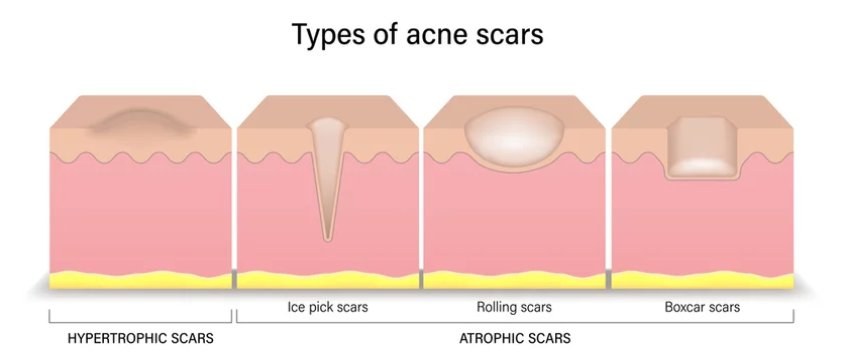
The main acne scar types, shown in cross-section. Ice pick, rolling, and boxcar scars are all atrophic (indented) scars.
Acne scarring is common, and treatable
of people with acne go on to develop some degree of acne scarring, so if you are dealing with it, you are in good company.
scars, the indented kind (ice pick, boxcar, and rolling), are the most common type of acne scarring.
is the key. Scars form from collagen damage, and resurfacing works by rebuilding it, which is why results keep improving over months.
Sources: peer-reviewed dermatology literature (Liu et al., 2023; clinical reviews of acne scar treatment).
Helix CO2 & 1570 Fractional Laser
The Helix fractional laser is our most advanced resurfacing technology and our primary treatment for acne scarring. It combines CO2 and 1570nm laser wavelengths to vaporize micro-columns of damaged skin while stimulating deep collagen production, smoothing indented scars and refining overall texture.
Because it works fractionally, treating tiny columns and leaving the surrounding skin intact, it heals faster and more comfortably than older, fully ablative lasers, and it is customizable for every skin type and tone.
- Targets atrophic (indented) scarring: ice pick, boxcar, and rolling scars
- Rebuilds collagen to fill and smooth depressed texture over time
- Refines overall tone and texture, not just individual scars
- Often achieves meaningful improvement in one to two treatments
- Customizable depth and intensity for your skin and your scarring
Clearing up some acne scar myths
There is a lot of misinformation about treating scars. Here is what the science actually says.
Acne scars will fade on their own with time
Flat dark marks often do fade, but true indented scars usually do not. Deep or pitted scars are changes in the skin’s structure, and meaningful improvement generally requires resurfacing that rebuilds collagen.
Creams and home remedies can erase scars
Topicals and at-home treatments can improve skin texture and surface tone, but they cannot repair deep scar tissue. Indented scarring responds to in-office resurfacing, not a serum alone.
Laser resurfacing thins the skin
It is the opposite. Fractional laser resurfacing stimulates your skin to build new collagen, making it stronger and smoother over time, not thinner.
Scars are only a cosmetic concern
Acne scarring is well documented to affect confidence and emotional wellbeing. Treating it is about how you feel in your skin, not just how it looks.
Before & after
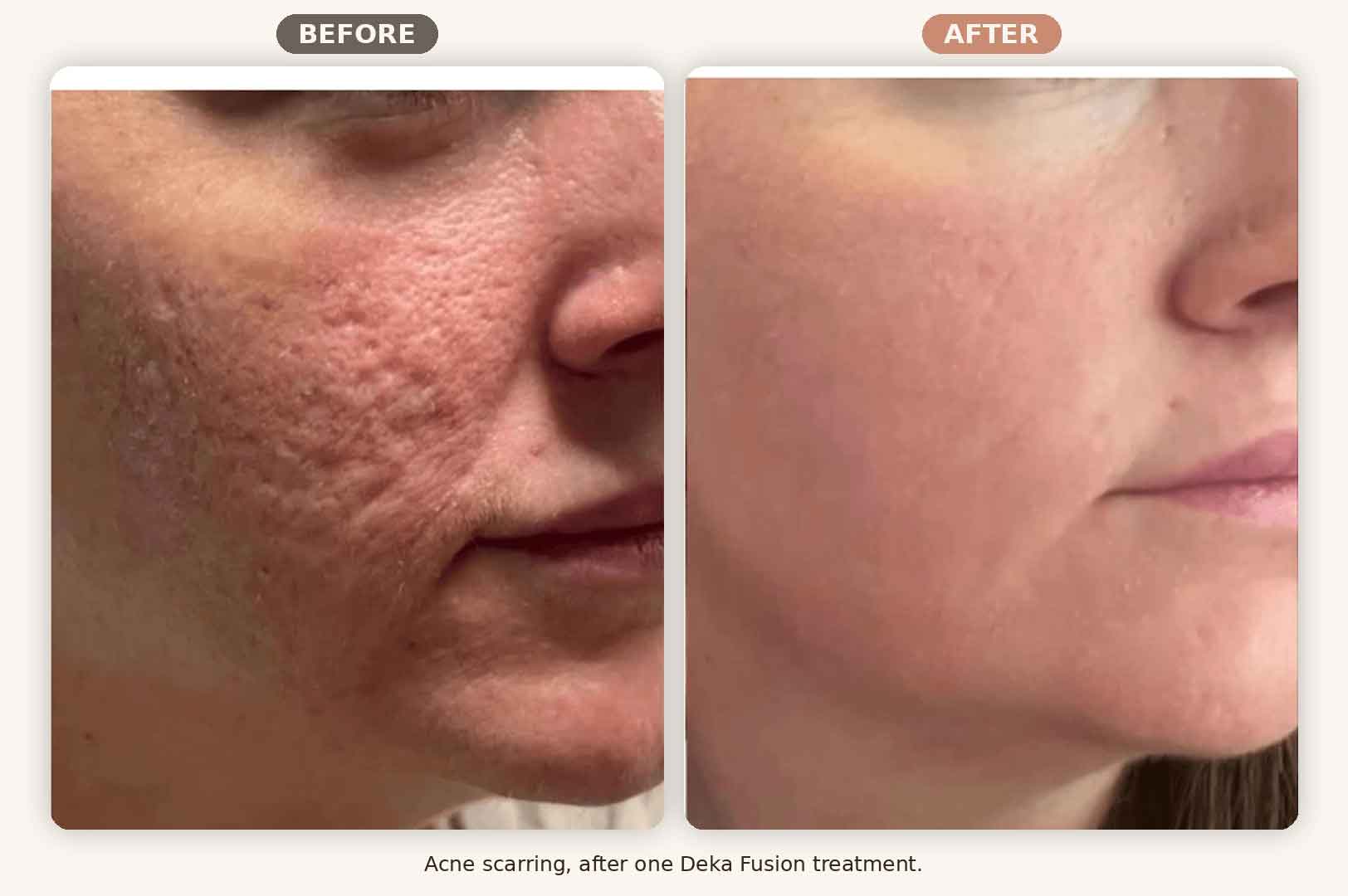
Deka Fusion, one treatment. Individual results may vary.
Acne scarring FAQ
Many people see meaningful improvement in a single Helix treatment, while deeper or more extensive scarring often does best with a series of two. Results continue to build for months afterward as collagen rebuilds. We give you a realistic plan at your consultation.
Downtime depends on the depth of treatment, and deeper resurfacing for scarring typically involves about five to six days of healing. You will receive detailed aftercare instructions and know exactly what to expect before your appointment.
Helix resurfacing is especially effective for atrophic (indented) scars, the ice pick, boxcar, and rolling scars that are the most common type. Raised scars are approached differently. At your consultation we look at exactly what kind of scarring you have and confirm the right treatment and settings for your skin.
We generally calm active breakouts first, then treat scarring once your skin is stable. Resurfacing active, inflamed skin is not ideal. If you are still dealing with breakouts, start with our acne page, and we will sequence your care.
Resurfacing significantly improves the appearance of scarring, often dramatically, but no treatment erases scars entirely. Our goal is smoother, more even skin you feel good in. We will give you an honest sense of what is realistic for your scarring at your consultation.
With a free consultation. We assess your scarring, confirm the right treatment and settings for your skin type, and build a personalized plan. Book your consultation here.
Still dealing with active breakouts?
See our Acne treatments →Smoother, more even skin
Acne scars do not have to be permanent. Let us assess your scarring and build a personalized resurfacing plan with the Helix CO2 laser, tailored to your skin.
Consultations are complimentary. We will help you find the right plan for your skin.