
Considering plasma fibroblast?
Here’s our honest take.
Plasma fibroblast treatment (often searched as a “plasma pen” treatment) was one of the services we offered. Then laser technology surpassed it for skin tightening and resurfacing, and we believe you deserve to know why we made the switch before you spend a dollar.
We performed this treatment. Here’s what we learned.
Plasma fibroblasting uses a small electrical arc to create micro-injuries in the skin. Those injuries trigger fibroblasts, the cells that produce collagen, to tighten and repair the treated area. It became popular as a non-surgical option for eyelid lifts, skin tightening, and wrinkle treatment, and for a time it was one of the services on our menu.
So this page is not a competitor talking down a treatment they never offered. We trained in the technique, performed it on real clients, and saw real results. We know exactly what this treatment can do, and more importantly, what it can’t. When we added the Helix CO2 and 1570 fractional laser platform, we retired our plasma device from skin tightening and resurfacing work, because we could no longer justify it next to what the laser delivers.
“I can’t in good faith perform a plasma fibroblast treatment on someone expecting the results my Helix laser delivers. It’s older technology for this purpose, and you get better results with the laser in far fewer treatments, which means less expense over time and less downtime.”
Julie Davis, Founder and Advanced Laser Technician, Renew MedSpa
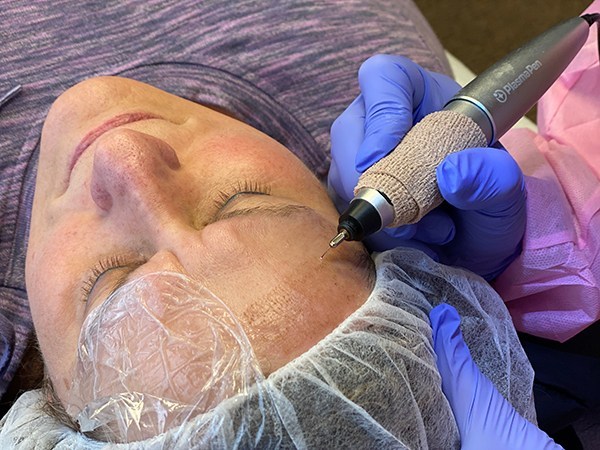
A plasma fibroblast treatment performed at Renew MedSpa
When better technology exists, you deserve to be offered it.
Plasma fibroblast treatment still works. But aesthetic technology has advanced, and the practices that invest in it can now reach the same goals more precisely, more comfortably, and often in fewer visits. We believe part of our job is to stay current on your behalf, so that when a smarter, safer, more effective option becomes available, it is the one we reach for first. That is the standard we hold ourselves to, and it is why we built our practice around advanced laser resurfacing.
Three things our plasma device can’t control
In any energy-based skin treatment, results and recovery come down to how precisely the injury is controlled. On the handheld plasma device we use, the technician can’t control the three variables that matter most. Plasma devices vary, and some newer systems add adjustable power settings, but even then, a handheld pen-style device still depends on the operator’s hand for spot placement, spacing, and timing. A medical laser platform dials in all three precisely and delivers them identically, spot after spot.
The size of the injury
Each plasma arc creates a wound whose size depends on hand position, distance, and the device itself. There’s no setting for it. The Helix laser delivers a computer-controlled spot size, exact and identical across the entire treatment area.
The depth
Depth determines how much change a treatment creates and how much risk it carries. On the device we use, depth can’t be set or measured. The Helix allows depth to be programmed precisely, from a gentle superficial pass to deep structural remodeling.
The dwell time
How long energy stays on the tissue drives the strength of the treatment and the length of your recovery. With a handheld pen-style device, dwell time depends on the operator’s hand. The laser times every pulse to the microsecond.
Plasma fibroblast vs. Helix CO2 laser
Both create controlled injuries that trigger collagen production. The difference is the word “controlled.”
Where the plasma device still earns its place
Mole and skin tag removal
For removing small individual lesions, a pinpoint plasma arc is genuinely the right tool, which is exactly why we still use our plasma device for this one purpose.
What we recommend for the results you came here for
If a plasma fibroblast treatment was on your list, one of these is almost certainly the concern behind it. Here’s where that goal lives at Renew today.
Helix Eyelid & Under Eye Tightening
The non-surgical eyelid lift, done with precise, programmable laser energy on the most delicate skin on your face.
Learn more →Helix CO2 & 1570 Fractional Laser
Face, neck, and body tightening and resurfacing with depth and strength tuned exactly to your skin and your downtime budget.
Learn more →CoolPeel + PDGF
Light resurfacing with growth factors for collagen building with minimal downtime, the modern answer to “I want better skin without a week at home.”
Learn more →CO2 Laser Stretch Mark & Scar Treatment
Deep, consistent fractional treatment that remodels stretch marks and scars with permanent results.
Learn more →Plasma fibroblast questions, answered straight
For one purpose only: mole and skin tag removal, where a pinpoint plasma arc is the right tool for the job. We no longer perform plasma fibroblast facelifts, eyelid lifts, skin tightening, or resurfacing, because our Helix laser delivers better results for those goals with fewer treatments and less downtime.
No, and we wouldn’t have offered it if it were. In trained hands it produces real results, and our own client history proves it. The honest issue is control: on the plasma device we use, the operator can’t set the injury size, depth, or dwell time, so the strength of the treatment and the recovery vary in ways a modern laser simply doesn’t. Once a precisely controllable alternative exists, “good” stops being good enough.
Some are. Several newer plasma fibroblast systems offer adjustable power settings and refined energy delivery, and they’re a genuine improvement over earlier devices like ours. But adjustable power is not the same as computer-controlled treatment. Even the most advanced handheld pen still relies on the operator’s hand for spot placement, spacing, and timing, while a fractional laser scans a programmed pattern with set depth and pulse duration at every single point. That gap is why we invested in the laser platform rather than a newer pen.
Because the technology around us improved and we followed the results. Our standard is the best outcome per dollar and per day of downtime, and when we put the Helix laser next to our plasma device for tightening and resurfacing, it wasn’t close. Retiring a service we were known for wasn’t an easy business decision, but it was the right clinical one.
Yes, and many of our clients have. Previous fibroblast treatment doesn’t prevent laser treatment once your skin is fully healed. At a complimentary consultation we’ll assess your skin, talk through what your earlier treatments did, and map the right Helix plan from there.
Per session, often yes. Per result, usually no. Because the laser creates a stronger, more consistent treatment, you typically need fewer sessions to reach your goal, which tends to make the total cost lower, along with fewer rounds of downtime. We’ll give you real numbers for your specific goals at your consultation.
Your first consultation is complimentary, and it’s a conversation, not a sales pitch. We look at your skin, listen to what you want to change, explain your options honestly (including when a smaller treatment is the right call), and build a plan with transparent pricing. If you want a deeper analysis, ask about adding a VISIA skin analysis to see what’s happening beneath the surface.
Come in for the truth, leave with a plan.
You came here researching plasma fibroblast treatments, which means you’re serious about your skin. Bring that same seriousness to a complimentary consultation and we’ll show you, honestly, what will actually get you the result you’re picturing.