Ozempic Face: Why Weight Loss Changes Your Face and What Actually Helps
The weight loss is the win. We have helped hundreds of people lose thousands of pounds, and watching someone reclaim their health is the most rewarding part of what we do. But there is a question that comes up again and again once the scale starts moving: why does my face look older?
If you have lost a significant amount of weight on a GLP-1 medication and noticed your face looking thinner, more hollow, or somehow less rested, you are not imagining it. This is the phenomenon social media has nicknamed “Ozempic face,” and it is one of the most common concerns we hear from people in the middle of a successful weight loss journey.
The good news: it is well understood, it is not damage, and there is a clear path to addressing it. Let’s walk through what is actually happening to your skin, why it happens, and what genuinely helps.
What “Ozempic Face” Actually Is
First, the name is misleading. The facial changes that come with rapid weight loss are not a side effect of the medication harming your skin. They are the result of fat loss, the same fat loss you are working hard to achieve everywhere else on your body.
Your face is built on a framework of fat. Beneath the skin sit a series of fat compartments, the malar (cheek) pads, the temporal (temple) pads, and the fat around the eyes, that give a youthful face its smooth, full, supported contour. When you lose weight, you lose it from everywhere, and unfortunately these facial fat pads are often among the first to deflate.
When that internal scaffolding shrinks, two things happen. The face can look more hollow and angular as underlying bone structure becomes more visible, and the skin that used to drape over a fuller structure now has more surface area than it needs, which can read as laxity or sagging. Clinicians describe this as a skin-volume mismatch: the skin looks loose because what was underneath it deflated, not necessarily because the skin itself failed.
These changes are the result of fat loss, not the medication harming your skin. The same thing happens with significant weight loss from any cause.
This is not unique to GLP-1 medications. The same facial changes happen with significant weight loss from any cause, including dieting, intense exercise, and bariatric surgery. GLP-1 medications simply made meaningful weight loss common and fast, which is exactly why this conversation is everywhere right now.
Why It Happens, and Why Speed Matters
Skin is remarkably adaptable, but it adapts on its own timeline. When weight comes off gradually, the skin and the soft tissue beneath it have time to contract and accommodate the new contour. When fat volume decreases faster than the skin can retract, the mismatch becomes visible.
Collagen and elastin are already declining. Skin collagen naturally decreases with age, and so does elastin, the protein that lets skin snap back after it stretches. Rapid volume change places mechanical demand on skin that, with age, already has less of both.
Rapid loss is harder on skin than gradual loss. Clinically, rapid weight reduction is consistently associated with greater skin laxity than slower, more gradual loss, because the skin has less time to retract. Age, genetics, hydration, sun history, and your baseline collagen density all influence how your skin responds.
The change can happen fast. Traditional facial aging unfolds over decades. With rapid weight loss, similar-looking changes can show up in a matter of months, which is part of why they feel so jarring. The face often shows it before the rest of the body does, because facial skin is thin and the underlying fat that supports it is limited to begin with.
Our Weight Loss Program
At Renew, our medically supervised weight loss program prescribes Zepbound. We have helped hundreds of people lose thousands of pounds, and we built the program to support the whole person, not just the number on the scale. That includes paying attention to what happens to your skin along the way.
Effective weight loss and a plan to support your skin are not in conflict. They belong together, which is exactly why this article exists. You can learn more about how the program works on our Zepbound weight loss page.
What Actually Helps: Build and Layer, Not Just Fill
Here is where our entire philosophy comes into focus. The instinct when a face looks deflated is to fill it back up. Sometimes that is exactly right, and we will get to that. But filling an empty contour without addressing the quality of the skin draped over it treats the symptom and ignores the foundation.
Our approach is to build and layer. Think of it in three tiers.
Protect skin during the loss
The best time to support your skin is while you are still losing. Prioritize protein to support collagen and tissue repair, add strength training to preserve lean mass and underlying structure, stay hydrated, and protect against sun damage. None of this is glamorous, and all of it matters.
Rebuild collagen and tighten skin
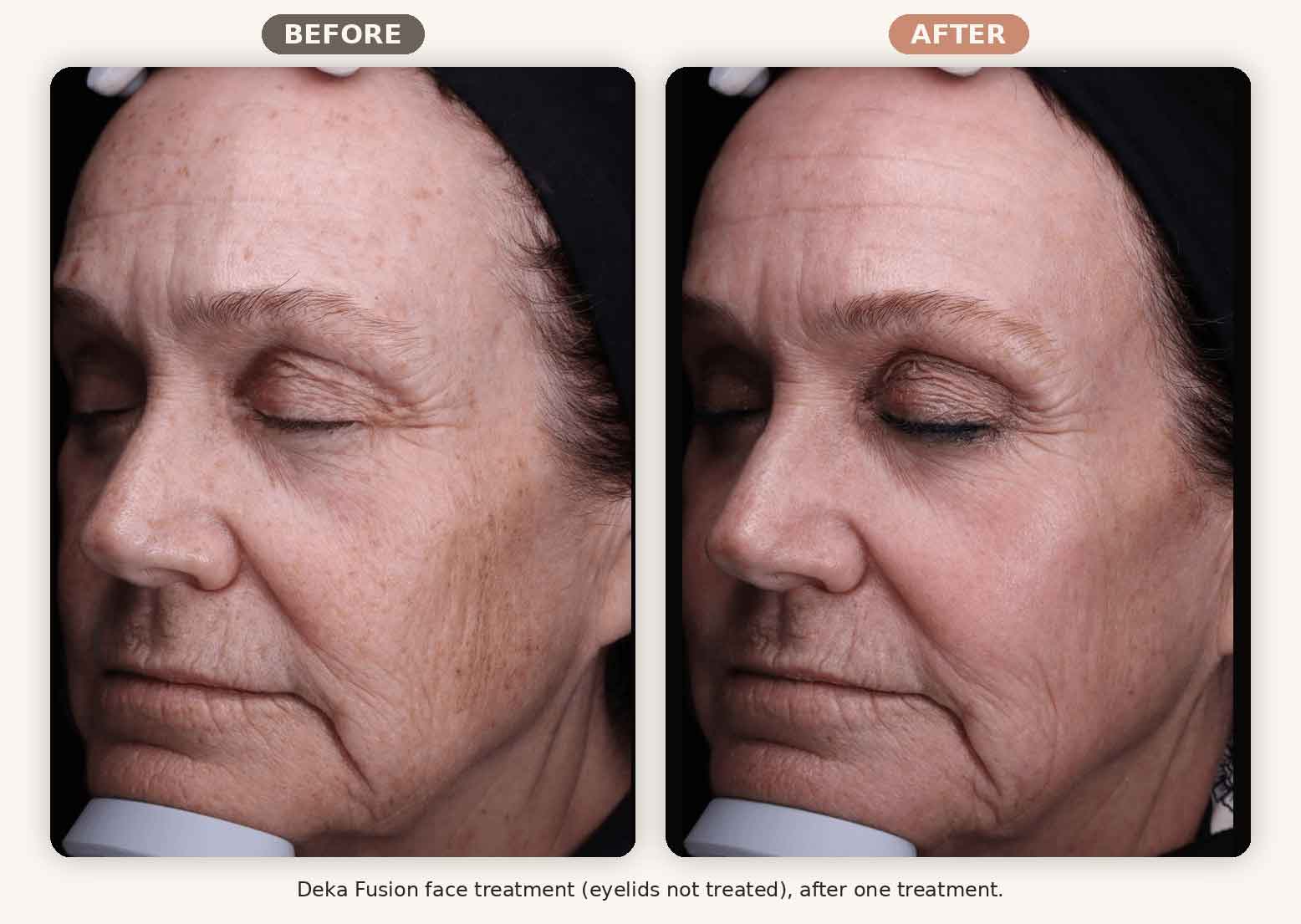
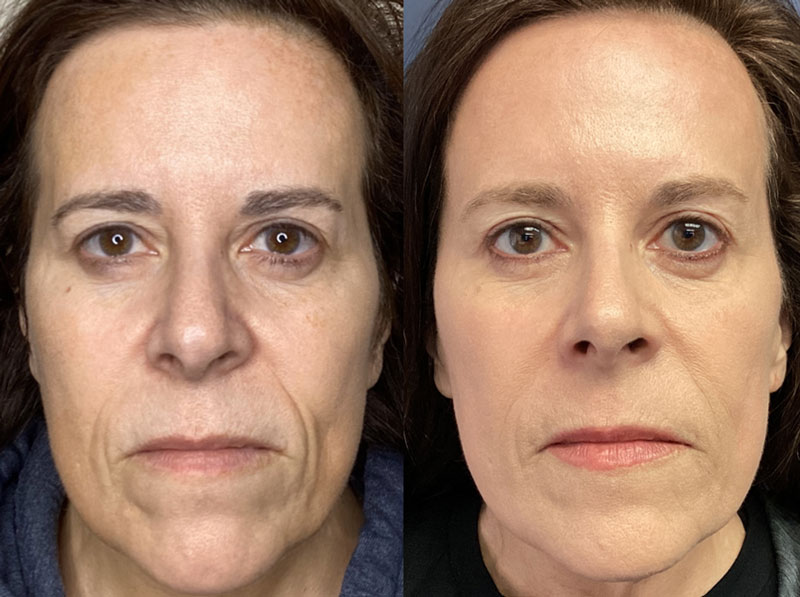
This is the heart of it. Treatments that stimulate your own collagen address laxity at the source. Our Helix CO2 and 1570 fractional laser remodels skin and tightens at depth, CoolPeel with PDGF supports regeneration with less downtime, and Sculptra builds your own structural collagen over months.
Rebuild structure and volume
Once the foundation is in place, restoring structure completes the picture. Sculptra rebuilds your own collagen, restoring volume while improving firmness, tightening, and radiance. There is also a time and place for dermal filler, which adds immediate volume and suits areas like the lips.
The sequence matters. Building skin quality and natural structure first means that any volume you add later sits on a healthier, firmer foundation, and you typically need less of it. That is the difference between looking restored and looking overfilled.
One more layer rounds out a complete plan. Weight loss deflation is mostly about lost volume and skin quality, but the lines that come from everyday expression, across the forehead, between the brows, and at the corners of the eyes, are a separate issue that often shows up alongside it. Neuromodulators like Botox, Dysport, and Jeuveau soften those dynamic lines by relaxing the muscles that create them. They will not restore volume or tighten loose skin, so they are not a fix for the hollowing itself, but as part of a layered plan they smooth the expression lines that building and restoring do not address.
A Quick Reference
| Concern after weight loss | What tends to help |
|---|---|
| Crepey, lax skin texture | Helix CO2 fractional laser, CoolPeel with PDGF |
| Loss of firmness and structure | Sculptra biostimulator, energy-based skin tightening |
| Dull, tired-looking skin and lost radiance | Sculptra biostimulator, Helix CO2 fractional laser, CoolPeel with PDGF |
| Hollow temples or cheeks | Sculptra for gradual rebuild; filler for immediate volume |
| Expression lines (forehead, frown lines, crow’s feet) | Neuromodulators (Botox, Dysport, Jeuveau) |
| Lip volume | Dermal filler |
| Prevention during active weight loss | Protein, strength training, hydration, sun protection, early collagen support |
How We Approach This at Renew MedSpa
Every face deflates a little differently, which is why we start with an honest assessment rather than a one-size-fits-all package. A complimentary consultation, often paired with a VISIA skin analysis, lets us see exactly where your skin is and build a plan in the right order for your goals, your timeline, and your budget.
And if you have not started your weight loss journey yet, we can talk about both sides at once: a medically supervised Zepbound program and a skin support plan designed to go with it from day one. That is the version we wish more people got to start with.
“One more thing, from me personally. I lost 60 pounds and have maintained that loss for over three years, so this is not theoretical for me. I have lived the win and I have lived the questions that come with it. That experience is a big part of why we built our weight loss program and our skin program to work together, instead of leaving people to figure out the second half on their own.”
Julie Davis, Founder and CEO, Renew MedSpa
Ozempic face, answered.
The underlying fat loss is structural, so it does not simply reverse on its own the way temporary side effects like nausea do. However, the appearance is very treatable. Collagen-building treatments, skin tightening, and volume restoration can meaningfully improve and in many cases fully address it.
You cannot prevent all facial fat loss, that is part of losing weight. But you can reduce how much loose skin you are left with. A measured pace, strong protein intake, strength training, hydration, sun protection, and starting collagen support early all help your skin keep up with the changes.
Filler has a real place, especially for immediate volume or for areas like the lips. But filling a deflated face without addressing skin quality treats only part of the picture and can look overdone if the foundation underneath is not supported. We generally build skin quality and natural structure first, then restore volume as needed. The right approach depends on your goals.
Our medically supervised weight loss program prescribes Zepbound. Every program is overseen by our provider and tailored to the individual. You can read more on our Zepbound weight loss page or at a complimentary consultation.
Before or during weight loss, not after. Supporting your skin while you are actively losing gives it the best chance to adapt and means less correction later. If you have already finished losing, that is completely fine too, we simply start from where you are.
Let’s build a plan.
Whether you are mid-journey and noticing changes, or just getting started, we can help you do this the supported way.
Wysong A, Joseph T, Kim D, Tang JY, Gladstone HB. Quantifying soft tissue loss in facial aging: a study in women using magnetic resonance imaging. Dermatologic Surgery. 2013;39(12):1895-1902.
Sadick NS, Dorizas AS, Krueger N, Nassar AH. The facial adipose system: its role in facial aging and approaches to volume restoration. Dermatologic Surgery. 2015;41 Suppl 1:S333-S339.