
What Really Happens to Your Skin, Decade by Decade
From your 20s to your 70s and beyond: what changes, when it starts, which layer it comes from, and why it is never too late to do something about it.
When a client meets with me for a consultation and says, “I just look tired,” or “I don’t like how I look anymore,” they are describing several changes happening at once, in different layers of the face, on different timelines.
Aging is not one event. It starts earlier than most people think, and it shows up in a fairly predictable order. Once you know which layer a change is coming from, it becomes much easier to understand why one treatment helps a concern and another does nothing for it. It is also why I rarely recommend just one thing.
Your face ages in six layers, on two clocks, at a pace that speeds up at predictable points. The more of that you understand, the less you waste on treatments aimed at the wrong layer.
This article walks through the layers of your skin and face, what changes in each one, roughly when those changes show up, and how the signs you see in the mirror trace back to what is happening underneath. If you only want your own decade, jump straight to it.
The six layers of your face
Your face ages in six layers, and each one ages differently. Most skincare only reaches the first.
The outer layer you see and touch. It makes new cells, holds in moisture, and contains melanocytes, the cells that make pigment. As it ages, cell turnover slows and the surface looks duller, rougher and less even in color.
The wavy border that anchors the epidermis to the dermis and helps feed it. Think of two hands with fingers interlocked: the deeper the grip, the more secure the hold. With age it flattens, so the surface is less anchored, more fragile and slower to heal.
The support layer, built mostly of collagen for strength, elastin for snap-back, and hyaluronic acid for hydration. This is where wrinkles, crepey texture and loss of firmness begin. It is also the layer that can rebuild, which is why I focus so much of my work here.
Separate fat pads that give the face its soft curves. Over time some deflate and some slide lower, which changes the shape of the face more than its surface.
The muscles of expression lift, squint and frown thousands of times a day. Repeated folding creases the skin above them, first only when you move and eventually at rest.
The foundation everything drapes over. With age the eye sockets widen and the cheekbones and jaw slowly recede, so the skin above has less to hold it up.
Skin is also not the same thickness everywhere on your face. An ultrasound study of 99 adults found the dermis thinnest at the outer forehead, just under 1 millimeter, and thickest at the corners of the mouth, about 1.3 millimeters. Women’s dermis generally measured thinner than men’s.1 That is one reason I adjust laser depth area by area instead of treating the whole face the same way.
When I evaluate a face, I am looking at all six layers. A deep fold beside the mouth may be partly skin, partly fat that has dropped, and partly bone that has receded. Treating only the surface of a layered problem is one of the most common reasons people feel a treatment “didn’t work.”
Two clocks: intrinsic and extrinsic aging
Your skin runs on two clocks at once.
Intrinsic aging is the genetic and hormonal clock everyone has. It brings fine, even wrinkling, thinner and drier skin, slower healing, gradual volume loss and the slow sagging that comes with time. You cannot stop this clock, but you can slow how much of it shows.
Extrinsic aging is everything the environment adds on top, and sun exposure is by far the biggest piece. In a study of 298 women ages 30 to 78, researchers concluded that UV exposure appears to be responsible for about 80 percent of visible facial aging signs.2 Sun exposure was strongly tied to pigment problems, while sagging tracked more with chronological age, and wrinkles and texture were driven by both. Smoking, pollution, poor sleep, high-sugar diets (sugar binds to collagen and stiffens it, a process called glycation) and repeated large weight swings add to the damage.
If most of what you see in the mirror comes from the second clock, most of it is also preventable, and much of it is treatable.
Compare the inside of your upper arm with the back of your hand. Same age, same genes, very different skin. The difference is the sun.
Sun damage is a skin health issue, too
Sun damage does more than add spots and wrinkles. Over years, UV exposure leaves patches of damaged cells that can turn into actinic keratoses, the rough, scaly spots I often feel before I see. Most never become cancer, but some do. In one large study of veterans, about two thirds of the squamous cell skin cancers that developed arose from a spot that had been recorded as an actinic keratosis.3
Research is also starting to suggest that resurfacing may do more than improve appearance. A Massachusetts General Hospital study followed 95 patients who had already been treated for a facial skin cancer. Over about six years, 20.9 percent of those who received non-ablative fractional laser treatments developed a new facial skin cancer, compared with 40.4 percent of those who did not.4 It is an encouraging finding, but I want to be careful with it. It was a small study that looked back at patient records, it used non-ablative lasers rather than the exact treatments I offer, and it cannot prove that laser prevents skin cancer. The researchers themselves say more work is needed. What it does suggest is that keeping skin healthy and keeping it looking good may overlap more than we thought.
Laser treatment at Renew MedSpa is not skin cancer treatment or a substitute for a dermatologist. A spot that bleeds, grows, changes or will not heal needs a dermatologist’s evaluation first, and I will always send you there before treating it.
Skin checks are for every decade
I recommend a professional skin exam with a board-certified dermatologist once a year for every adult, at every age, plus a quick look at your own skin once a month. That follows the Skin Cancer Foundation’s guidance.5 If you have had skin cancer before or are at higher risk, your dermatologist may want to see you more often.
When you check your own skin, look for anything new, anything changing, and anything that itches or bleeds. The American Academy of Dermatology notes that regular checks help catch skin cancer early, when it is highly treatable.6 If something looks different, do not wait for your yearly visit. Make the appointment.
What happens and when: your skin by decade
Everyone ages on their own schedule, shaped by genetics, sun history and lifestyle. These are the patterns I see most often in my treatment room, along with what the research shows is happening underneath. The numbers below are averages from studies, not a forecast for you. Your own pace can be quite different.
Roughly how much skin collagen declines each year after it peaks in your early to mid 20s.7
When bone loss below the eye socket starts to become noticeable, continuing into the 60s.8
Of skin collagen that can be lost in the first five years after menopause.9
Your 20s: the quiet decline begins
- Collagen production peaks in your early to mid 20s and then declines by roughly 1 percent a year.7
- Cell turnover starts to slow, so the surface begins to lose a little of its natural glow.
- Sun damage is collecting below the surface, but most of it will not show for another decade or more.
- The first expression lines may appear on the forehead or around the eyes, but only when you move.
What you see: very little. That is exactly why this is the decade where daily sunscreen does the most good.
Best habit this decade: Wear a broad-spectrum SPF 30 or higher every day, rain or shine, and skip the tanning. Nothing you do later will pay off as much.
Your 30s: the first visible changes
- Turnover is noticeably slower, and skin can look duller or more tired, especially after a poor night’s sleep.
- Fine lines around the eyes linger longer after you smile.
- Sun spots and uneven tone start to surface, the delayed result of sun exposure in your teens and 20s.
- The first volume shift often shows under the eyes as a hollow or shadow.
- Bone remodeling begins quietly in the midface, with the most noticeable resorption below the eye socket from the late 30s into the 60s.8
What you see: tired eyes, the first spots, lines that do not bounce back as fast.
Best habit this decade: Build a simple morning and night routine you will actually keep. Consistency beats intensity.
Your 40s: changes speed up
- For women, perimenopause begins and falling estrogen starts to affect collagen, hydration and oil production.
- Expression lines that used to disappear now stay at rest, especially the 11s between the brows and the crow’s feet.
- The midface flattens as fat pads deflate and descend, and the folds from the nose to the mouth deepen.
- Texture changes become more noticeable: larger-looking pores, roughness, redness and broken capillaries.
- Skin is thinner and takes longer to recover from a breakout, a scratch or a treatment.
What you see: lines at rest, flatter cheeks, deeper folds and texture that makeup no longer hides.
Best habit this decade: Extend your SPF and home care to your neck, chest and the backs of your hands. They age right along with your face and usually get forgotten.
Your 50s: the menopause shift
- Up to 30 percent of skin collagen can be lost in the first five years after menopause, followed by a slower decline of about 2 percent a year.9 Skin collagen tracks more closely with years since menopause than with age alone.10
- Skin becomes drier and more crepey, especially around the eyes, neck and chest.
- The jawline softens and jowls form as fat shifts lower, skin loosens and the jaw bone recedes.
- Lips thin and fine vertical lines appear around the mouth.
What you see: crepey skin, a softer jawline and lines around the mouth, often arriving faster than in any decade before.
Best habit this decade: Be kind to a drier, thinner barrier: gentle cleansing, a richer moisturizer and sunscreen every single day.
Your 60s: structure and support
- The dermis is thinner and more fragile, so bruising is easier and healing is slower.
- Loss of bone in the eye sockets, midface and jaw becomes a bigger part of the picture.
- Laxity, or looseness, becomes the main concern rather than individual lines.
- Years of sun exposure show up as deeper pigment, rough patches and more visible blood vessels.
What you see: looseness more than lines, and sun damage you can feel as well as see.
Best habit this decade: Protect fragile skin outdoors with a wide-brimmed hat and sunscreen, and moisturize daily to keep the barrier strong.
Your 70s and beyond: thinner, slower to repair, and never too late
- Skin continues to thin and becomes drier as oil production and the moisture barrier decline.
- Skin becomes more delicate and can bruise or tear with minor bumps.
- Fewer active collagen-making cells means repair takes noticeably longer, so treatments are chosen with recovery and comfort in mind.
- Brown spots, raised growths and rough patches become more common, so your yearly skin check with a dermatologist matters more than ever.
- Folds and laxity deepen as fat, bone and skin support continue to decline together.
- The goals shift toward healthy, comfortable skin that looks fresh and cared for.
- It is never too late. Fibroblasts, the cells that make collagen, can be stimulated at any age. Results build more slowly, and the right plan starts with a consultation that sets realistic expectations for your skin.
What you see: thinner, drier skin, more spots worth having checked, and skin that still responds to good care.
Best habit this decade: Keep your yearly skin check, choose gentle products, and keep moisturizing. Your skin still responds to good care.
From my treatment room
She was 79. I would have guessed 65.
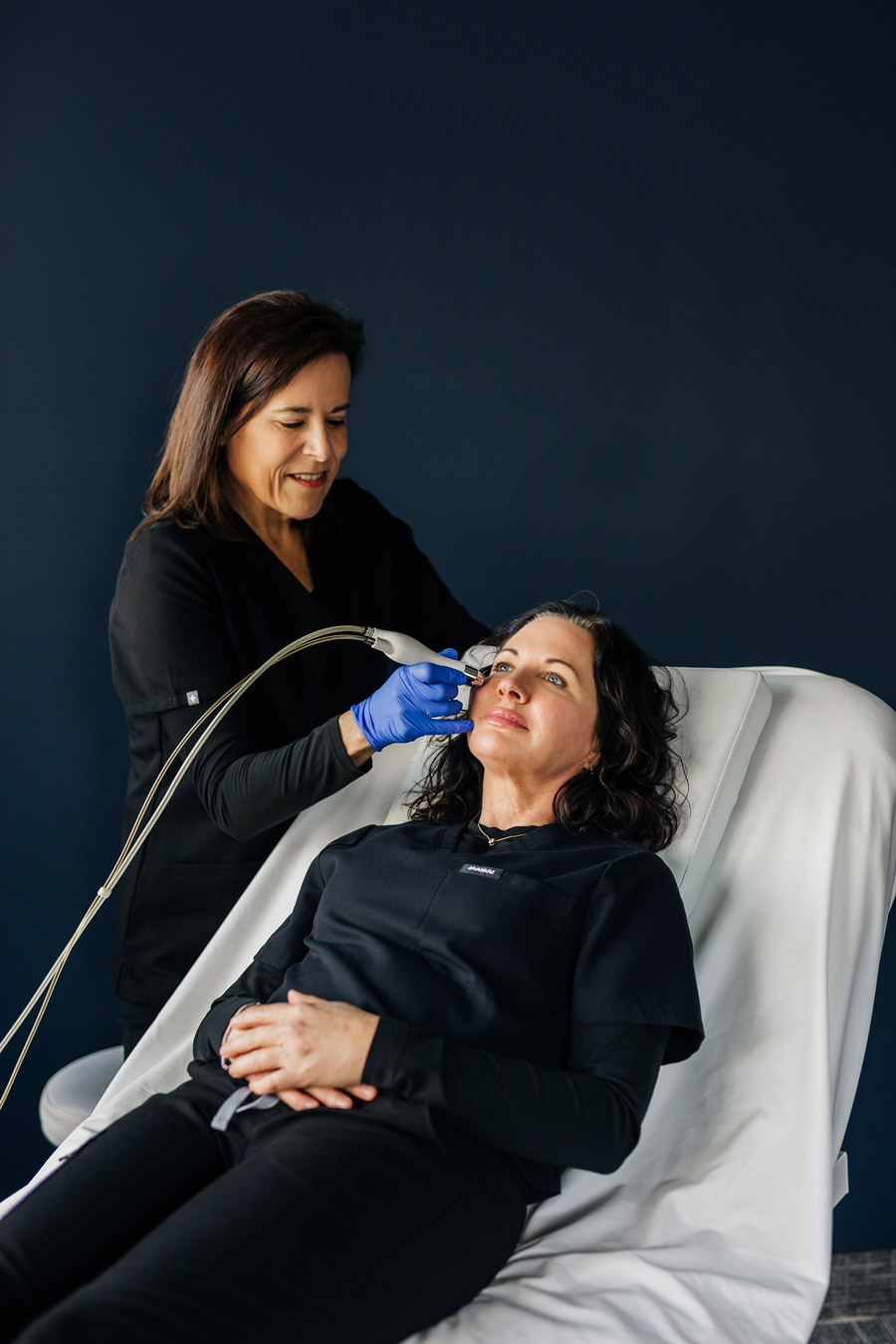
A client came in for a Helix laser consultation, and when I learned her age, I was floored. She had been doing aesthetic treatments since her 40s. Not all at once and not as a rescue, but consistently, the way you care for anything you want to last.
To me, she was more proof of what I see every day. These treatments work, and when you treat them as aesthetic self-care rather than a once-in-a-while fix, you really can age gracefully. If you are starting later than she did, that is fine too. The best time to start was years ago. The next best time is now.
A note for men
Men start with thicker skin and more collagen, and they do not go through a sudden hormonal drop the way women do at menopause. Their decline tends to be steadier. Many men, however, have had more unprotected sun exposure, which levels the playing field faster than they expect.
A note on skin of color
Deeper skin tones carry more melanin, which gives some built-in protection from sun aging, so lines and spots often show up later. The tradeoff is that pigment cells react more strongly to heat and inflammation, so uneven tone and dark marks after irritation are the more common concerns. Treatments can still work beautifully. The plan is simply built more carefully, with skin prep in the weeks before and gentler, more widely spaced laser settings.
A quick look at treatments by decade
People always ask me what they should be doing at their age, so here is a hint. These are the treatments clients at Renew MedSpa most often start exploring in each decade. Think of it as a starting point for a conversation, not a prescription.
| Decade | Treatments clients often explore |
|---|---|
| 20s | Daily SPF and professional skincare, Love Your Skin signature facials, Helix CoolPeel PDGF for glow and texture, and Botox for strong expression lines. Helix Deka Fusion only when acne scarring is the concern |
| 30s | Helix Deka Fusion laser resurfacing, Botox, VI Peel, and IPL for early sun spots and redness |
| 40s | Helix Deka Fusion, Sculptra and Botox, an excellent combination for this decade, plus IPL for sun spots and redness |
| 50s | Helix Deka Fusion, Sculptra and Botox, the same excellent combination, with the neck and chest treated along with the face |
| 60s | Helix Deka Fusion with settings chosen for your healing, Sculptra, Botox, and IPL for sun damage and visible vessels |
| 70s+ | Helix Deka Fusion with settings chosen for comfort and recovery, Sculptra, Botox where it fits, and barrier-focused facials and skincare |
| Every decade | Daily sunscreen, consistent home care and a yearly skin check with your dermatologist |
Why Helix Deka Fusion shows up so often
Helix Deka Fusion is a fractional laser treatment that combines two wavelengths in one session. Fractional means the laser treats thousands of tiny columns of skin and leaves the skin between them untouched, so it heals much faster than traditional CO2 resurfacing, which removes the entire surface layer at once. Within those columns, CO2 resurfaces the skin’s surface, and the 1570nm wavelength works deeper to stimulate new collagen. Together they address texture, tone, lines and firmness in one treatment, which is why it is the resurfacing treatment I recommend most.
It is only possible on the Helix laser. Many practices have CO2 lasers that offer CoolPeel, which is an excellent lighter treatment, but without the second wavelength they cannot offer Helix Deka Fusion. So if you have had a CoolPeel somewhere else and wondered whether there is a next step, this is it.
Curious what healing actually looks like? I walk through it day by day in What to Expect After a CO2 Fractional Laser Treatment, and When.
Two people the same age can need completely different plans. Your skin type, sun history, health, goals, budget and how much downtime you have all change what makes sense for you. A consultation is where we figure that out together. Where I list Helix Deka Fusion, for example, a lighter Helix CoolPeel or CoolPeel Fusion may be the better fit for you, and that is a decision we make together at your consultation.
Ready to find out what makes sense for your skin? Book a free consultation.
Why I start with a consultation, not a checklist
It is tempting to read an article like this, or that table, look in the mirror and decide what you need. I understand the impulse, but the mirror only shows the surface. Most signs of aging have more than one source, and what looks like one problem is often two or three layers changing at once.
The folds beside the mouth are a good example. In one person they come mostly from skin that has lost collagen. In another, they come from cheek fat that has dropped and bone that has receded, and a treatment aimed at the skin would barely touch them. They look similar in a photo. They are not the same problem, and they do not get the same plan.
The order of treatments matters too, and it is different for every face. That is why every plan at Renew MedSpa starts with a consultation, where I look at every layer, explain what I see and build the plan around your goals, your timeline and your budget. For more on how I think about long-term care, read How to Age Gracefully.
Questions we hear about this
Collagen begins its slow decline in your mid 20s, and sun damage starts collecting long before it shows. Most people notice the first visible changes in their 30s.
You cannot stop the intrinsic clock, but you can rebuild a meaningful amount of what has been lost. Treatments that stimulate collagen, like fractional laser and Sculptra, help your skin make new support of its own.
No. I believe it is never too late, no matter how old you are. It starts with a consultation with a trained professional who can guide you on realistic expectations and the treatments and products that are right for you and your skin.
Daily sunscreen is the single most effective thing you can do, and good home care supports every result. Topical products work mostly at the surface, though, so they cannot reach the muscle, fat or bone changes that shape the face.
Often the treatment was aimed at the wrong layer. A surface treatment cannot fix a volume problem, and Botox cannot fix sun spots. Knowing the source is the first step.
Mostly appearance. One small study found fewer new facial skin cancers in patients who had non-ablative fractional laser treatments than in those who did not,4 but it cannot prove that laser prevents skin cancer, and I do not offer it for that reason. It is not a cancer treatment, and any spot that bleeds, grows, changes or will not heal should be seen by a dermatologist first.
Start with a layer-by-layer consultation
Aging is not something to fight. It is something to understand, and then to support well. At your consultation at Renew MedSpa, I will look at every layer with you, explain what I see, and build a plan around your goals and your timeline. Please book ahead so we can be here and ready for you.
References
- 1. Jeong KM, Seo JY, Kim A, et al. Ultrasonographic analysis of facial skin thickness in relation to age, site, sex, and body mass index. Skin Research and Technology. 2023;29(8):e13426. https://doi.org/10.1111/srt.13426
- 2. Flament F, Bazin R, Laquieze S, et al. Effect of the sun on visible clinical signs of aging in Caucasian skin. Clinical, Cosmetic and Investigational Dermatology. 2013;6:221-232. https://pmc.ncbi.nlm.nih.gov/articles/PMC3790843/
- 3. Criscione VD, Weinstock MA, Naylor MF, et al. Actinic keratoses: natural history and risk of malignant transformation in the Veterans Affairs Topical Tretinoin Chemoprevention Trial. Cancer. 2009;115(11):2523-2530. https://pubmed.ncbi.nlm.nih.gov/19382202/
- 4. Benson TA, Hibler BP, Kotliar D, Avram M. Nonablative fractional laser treatment is associated with a decreased risk of subsequent facial keratinocyte carcinoma development. Dermatologic Surgery. 2023;49(2):149-154. Summary at The ASCO Post
- 5. The Skin Cancer Foundation. If You Can Spot It, You Can Stop It: recommends adults see a dermatologist at least once a year for a skin exam and perform monthly self-exams at home. https://www.skincancer.org/press/if-you-can-spot-it-you-can-stop-it
- 6. American Academy of Dermatology. Find skin cancer: how to perform a skin self-exam. https://www.aad.org/public/diseases/skin-cancer/find/check-skin
- 7. Shuster S, Black MM, McVitie E. The influence of age and sex on skin thickness, skin collagen and density. British Journal of Dermatology. 1975;93(6):639-643.
- 8. Mendelson B, Wong CH. Changes in the facial skeleton with aging: implications and clinical applications in facial rejuvenation. Aesthetic Plastic Surgery. 2012;36(4):753-760. https://pmc.ncbi.nlm.nih.gov/articles/PMC7447647/
- 9. Calleja-Agius J, Muscat-Baron Y, Brincat MP. Skin ageing. Menopause International. 2007;13(2):60-64. Full text
- 10. Brincat M, Kabalan S, Studd JW, et al. A study of the decrease of skin collagen content, skin thickness, and bone mass in the postmenopausal woman. Obstetrics and Gynecology. 1987;70(6):840-845. https://pubmed.ncbi.nlm.nih.gov/3120067/
This article is for educational purposes and is not a substitute for a personal medical evaluation.